
An emergency personal loan for bad credit can help you cover unexpected expenses when you need money quickly. However, borrowers with lower credit scores may face higher interest rates and fees.
Understanding how these loans work, comparing lenders, and reviewing the terms carefully can help you find suitable financing while avoiding costly borrowing traps. Read on CredHelper.
How do bad credit emergency loans work?
CredHelper by email
Get our credit guides in your inbox
Plain-English guides that help you make the next move with your credit.
- Reviews of cards for bad or limited credit
- Step-by-step guides to build or rebuild credit
- Help finding loans, benefits and assistance programs
An unexpected medical emergency, urgent car repair, or sudden home maintenance expense can disrupt your finances without warning.
When faced with an immediate cash shortfall, having a less-than-perfect credit score adds significant stress to an already challenging situation.
Traditional financial institutions often reject loan applications from borrowers with poor credit or low FICO scores, leaving few visible options during a crisis.
Subprime emergency personal loans operate as fixed-rate installment loans. Once approved, the lender disburses the loan amount as a lump-sum payment directly into your checking account.
You then repay the debt through fixed monthly installments covering both principal and interest over a predetermined repayment term—typically ranging from 12 to 60 months.
Unlike secured loans (such as auto title loans or pawn shop loans) that require pledging valuable physical collateral that you risk losing if you default, most emergency personal loans are unsecured.
Lenders offset the increased financial risk of lending to bad-credit applicants by charging higher Annual Percentage Rates (APRs) and origination fees rather than demanding property collateral.
To understand the foundational mechanics of installment borrowing, review the Experian personal loan overview.
Can you get approved without a minimum credit score?
Yes, getting approved for an emergency personal loan without meeting a high minimum credit score threshold is entirely possible.
While traditional commercial banks often enforce rigid FICO score cutoffs (frequently requiring a score of 660 or higher), specialized subprime lenders utilize expanded risk-assessment algorithms.
When reviewing applications from borrowers with credit scores below 580 or limited credit history, bad-credit lenders prioritize alternative financial indicators:
- Consistent monthly income: lenders verify that you have a steady, predictable income stream from regular employment, self-employment, disability benefits, or retirement distributions;
- Debt-to-Income (DTI) ratio: underwriters calculate your total monthly debt payments relative to your gross monthly income. A DTI ratio below 45% or 50% demonstrates that you have sufficient remaining cash flow to handle a new monthly loan payment;
- Checking account stability: maintaining an active, positive bank account balance free from recurring overdrafts or non-sufficient funds (NSF) charges signals responsible daily money management.
Specialized online lending platforms cater directly to borrowers across all credit spectrums.
For instance, the OppLoans personal loans portal illustrates how subprime lenders evaluate income stability and bank account history to provide fast-funding installment loans without requiring minimum credit scores.
Step-by-step: how to apply for an emergency personal loan online
Applying for an emergency personal loan online allows you to request funds, complete identity verification, and receive approval from the comfort of your home. Follow these steps:
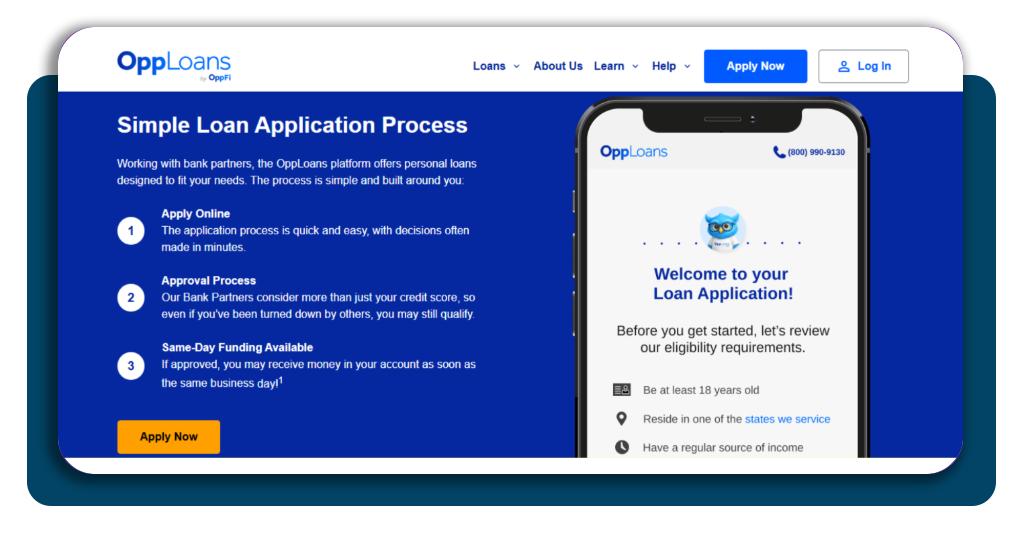
Step 1: access the portal and select your state
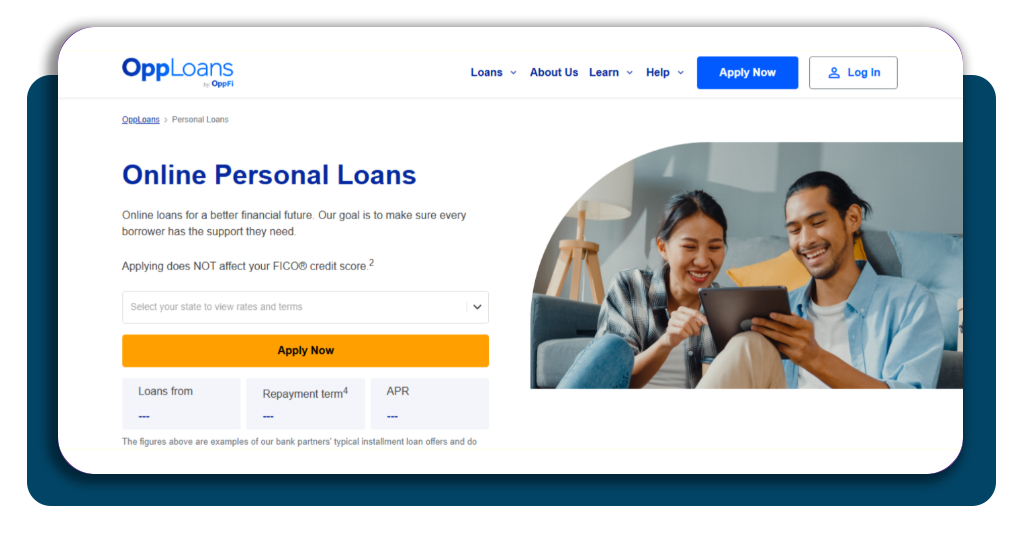
Navigate to the OppLoans website, click “Apply Now”, and select your state of residence.
OppLoans operates in specific U.S. states through bank partners, so verifying state availability ensures you receive accurate local rates and terms.
Step 2: provide personal identity information
Fill in your full legal name, current residential address, primary phone number, email address, date of birth, and Social Security number (SSN).
This information establishes your identity without generating a hard inquiry on your main FICO score.
Step 3: submit income and employment details
Input your current source of income (traditional employment, self-employment, benefits, or retirement distributions), pay frequency (weekly, bi-weekly, or monthly), and gross earnings.
OppLoans evaluates income stability rather than enforcing a strict minimum credit score.
Step 4: connect bank account information
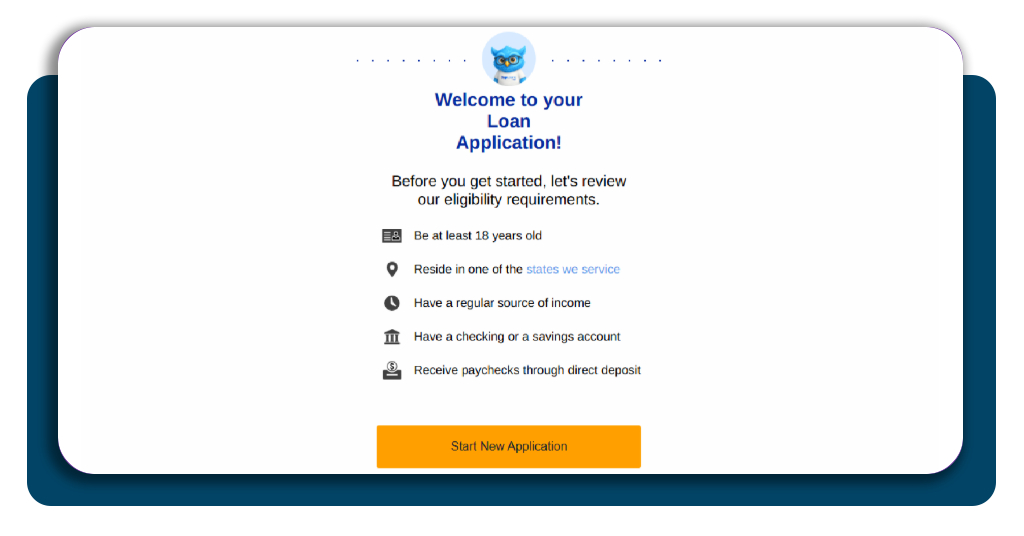
Enter your checking account routing number and account number. OppLoans requires an active checking account that supports direct deposit to verify cash flow and disburse approved loan funds.
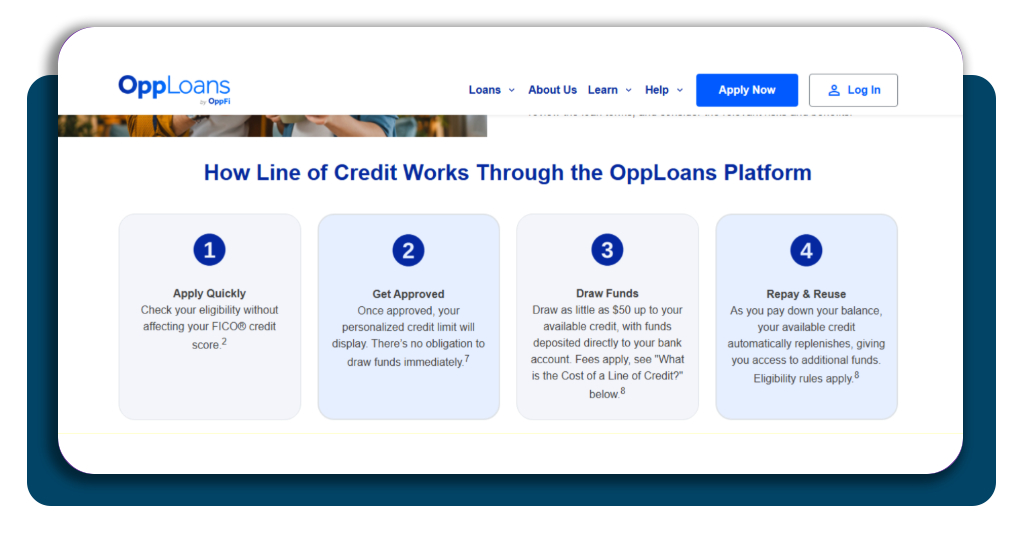
View your conditional decision, loan amount offer (typically ranging between $500 and $4,000 depending on state regulations), APR, and installment schedule.
If you accept the terms, digitally e-sign your loan agreement to finalize the application.
Rates, fees, and funding timelines explained
Before applying for an emergency loan with bad credit, it’s important to understand the potential costs.
Lenders may charge higher interest rates and origination fees to offset the added risk of lending to borrowers with lower credit scores.
Annual Percentage Rates (APRs)
The APR represents the true annual cost of borrowing, incorporating both the base interest rate and mandatory upfront fees.
For borrowers with poor credit, APRs generally range between 18% and 35.99% (the cap enforced by regulatory authorities in most states for consumer installment loans).
Upfront origination fees
Many subprime lenders charge an origination fee to process the application. Ranging from 1% to 10% of the total loan amount, this fee is typically deducted directly from your loan proceeds before transfer.
For example, on a 3,000 loan carrying a 5% origination fee (150), the lender disburses $2,850 to your account while you repay the full $3,000 principal.
Funding timelines
Speed is crucial during financial emergencies. Most online subprime lenders process applications within hours.
If you complete verification and e-sign your loan agreement before daily cutoffs (usually 11:00 AM or 1:00 PM EST), funds are frequently deposited into your checking account by the next business day.
Or even same-day via expedited debit card transfers.
Tips to pay off emergency debt safely and quickly
Taking on high-interest emergency debt should be a temporary solution. Once the immediate crisis passes, adopting proactive repayment habits protects your long-term finances and reduces interest overhead:
Automate monthly payments
Set up automatic ACH payments from your checking account. Autopay eliminates the risk of missed due dates and late fees, while many lenders offer a 0.25% APR discount for enabling automatic drafts.
Make bi-weekly principal payments
Split your monthly payment into two equal bi-weekly payments.
Making half-payments every two weeks results in 26 half-payments per year—the equivalent of 13 full monthly payments—shortening your loan payoff schedule and reducing total interest.
Pay down principal early
Verify that your loan contract carries zero prepayment penalties.
Whenever you receive unexpected cash—such as tax refunds, work bonuses, or side hustle earnings—apply those extra funds directly toward your principal balance to lower your overall interest burden.
To explore strategic techniques for eliminating high-interest installment debt ahead of schedule, read our comprehensive guide on how to pay off a personal loan faster.
Making informed decisions during a financial emergency
An emergency personal loan may help cover unexpected expenses when your credit score limits your borrowing options.
Before applying, compare lenders, review prequalification offers when available, and check the APR, fees, and repayment terms to understand the full cost.
Choosing payments that fit your budget can help you manage the immediate expense without adding unnecessary financial strain, while making on-time payments may support your credit history over time.