
When a debt collector calls, the knee-jerk reaction for many is to simply stop answering the phone. But it’s a risky game to ignore a collection account, as it rarely results in the debt just ‘disappearing’. Thanks to improved automated tracking and tighter adherence to Regulation F, debt buyers are better than ever at pushing accounts with no signs of activity.
In the short term, quiet can mean peace, but it also often signals to agencies that they are free to pursue more aggressive legal remedies. Knowing how debt collection works is essential to saving your financial future and avoiding the long-term damage of total avoidance. Read this and more on CredHelper.
What happens if you ignore a collection account
If you decide to ignore a collection account, the agency commonly follows a predictable escalation path. Initially, they will attempt to contact you via phone and mail.
Under current 2026 regulations (Regulation F), they are generally limited to seven calls within a seven-day period. If these attempts fail, the agency may sell your debt to a ‘junk debt buyer’ or pass it to a specialized law firm.
Collectors will often read your silence as ‘judgment proof’ or just not wanting to pay your obligations. This perception tends to lead to an escalation from soft collection efforts (calls and letters) to hard collection efforts (litigation).
Legal and credit score consequences
The impact of an ignored collection is felt most sharply in your credit report and, eventually, in a courtroom:
Credit score destruction
A collection account can drop a ‘Good’ credit score by as many as 100 points in a single reporting cycle.
By now, where the average credit score is approximately 714, a drop of this magnitude can push you from ‘Good’ to ‘Fair’ or ‘Poor’, making it nearly impossible to secure competitive interest rates.
The default judgment
If a collector sues and you don’t respond, the court will likely issue a default judgment. This is a legal confirmation that you owe the debt, and it gives the creditor powerful tools to collect.
Wage garnishment
With a judgment in hand, creditors can legally require your employer to withhold a portion of your paycheck—sometimes up to 25% of your disposable income—until the debt is settled.
Bank account levies
A judgment may also allow a creditor to ‘freeze’ your bank account and withdraw funds directly to satisfy the debt.
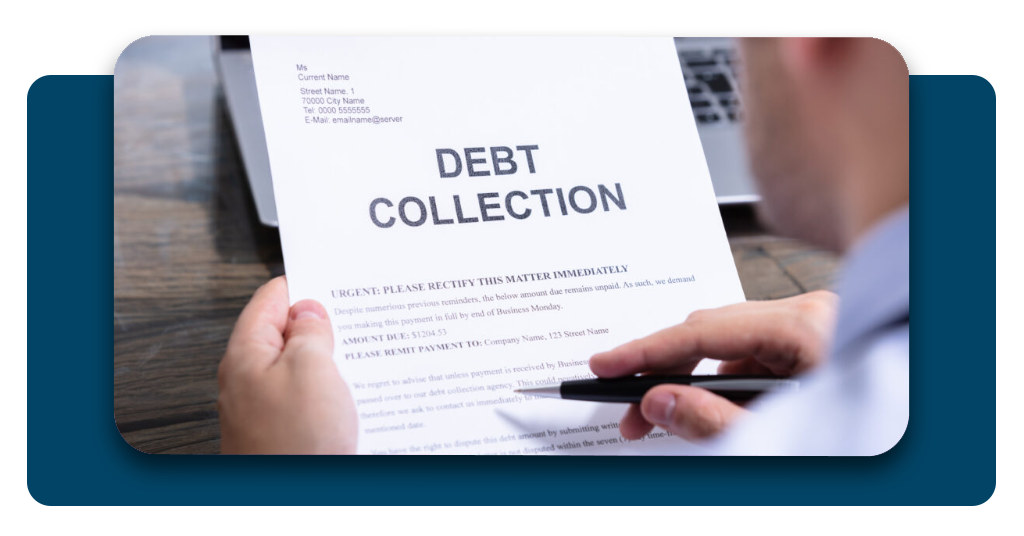
Risks of doing nothing vs. taking action
The primary risk of ‘doing nothing’ is that you lose control over the outcome.
When you ignore a collection account, you essentially allow the creditor to dictate the terms of your financial life.
Furthermore, ignoring the debt means you miss the opportunity to verify if the debt is even legitimate.
Debt portfolios are sold frequently; errors in documentation are common, and taking action allows you to challenge a debt that might be past the statute of limitations.
Step-by-step: what to do instead of ignoring it
If you are currently facing a collection, stop the avoidance cycle—ahead, some few steps that may help you regain your footing:
Step 1: request debt validation
Within five days of initial contact, the collector must send a validation notice. If they don’t, or if you suspect the debt isn’t yours, send a ‘Debt Validation Letter.’ By law, they must stop collection activity until they provide proof.
Step 2: verify the statute of limitations
Every state has a time limit (usually 3–10 years) after which you cannot be legally sued for a debt. If the debt is ‘time-barred’, you are under no legal obligation to pay, though it may still appear on your credit report.
Step 3: audit your credit report
Check your reports via Equifax, Experian, and TransUnion. Ensure the collection isn’t a result of identity theft.
Step 4: respond to summons
If you receive a court summons, do not ignore it. Even if you owe the money, showing up allows you to negotiate a settlement before a judgment is entered.

How to resolve or negotiate collections properly
Negotiating a collection can be easier than most people realize because debt buyers often purchase your debt for pennies on the dollar.
They are (with a certain frequency) willing to settle for a fraction of the original balance to avoid the costs of a lawsuit.
- Lump-sum settlement: offer a one-time payment of 30% to 50% of the total balance. Many agencies will accept this to close the account immediately;
- Payment plans: if you can’t afford a lump sum, propose a monthly amount that fits your budget. Ensure the agreement is in writing and that they agree not to pursue further legal action as long as you pay;
- Get it in writing: never make a payment until you have a signed agreement stating that the payment settles the debt in full;
- Understand tax implications: if a creditor forgives more than $600 of debt, you may receive a 1099-C form, as the IRS considers forgiven debt taxable income.
Ignoring the problem does not pause the system
Debt collection operates on timelines, records, and persistence, and silence rarely interrupts that machinery for long.
When you ignore a collection account, the consequences usually grow slowly enough to feel invisible at first, which is what makes the habit dangerous.
Problems that develop quietly are often the ones people underestimate most. Addressing the issue is uncomfortable, yes. But financially speaking, discomfort tends to be cheaper than avoidance.
While it is tempting to ignore a collection account, the financial landscape makes avoidance a losing game.
If I can give you advice, well, engage with the collector, validate the debt, and negotiate a settlement so you can protect your wages and begin the process of rebuilding your credit.
For more information on your rights and whether a debt can be legally written off, consult the experts at StepChange.